

 English
 русский
 Español
 中文简体

Steel Slip Yoke Helps Manage Driveshaft Length Changes
Date:Oct 09, 2026
A Steel Slip Yoke is a connection component within a driveshaft system that allows axial movement while continuing to transmit rotational force. This function becomes important when the distance between drivetrain components changes as the suspension moves. Instead of forcing the driveshaft to remain at one fixed length, the sliding connection gives the assembly room to accommodate movement.
Axial Movement Is Part of Driveshaft Operation
A Steel Slip Yoke works with a splined shaft so the driveshaft can extend or shorten along its axis. In a vehicle using a suspension system, the relative position of drivetrain components can change as the vehicle moves over uneven surfaces.
The sliding mechanism allows this change without requiring the entire driveshaft to change length as a rigid structure. This makes the component particularly relevant to sliding yoke applications in rear-wheel-drive and four-wheel-drive vehicles.
The Spline Transfers Torque and Allows Movement
The key feature of a Steel Slip Yoke is the spline connection. The internal spline engages with the mating shaft, allowing rotational force to pass through while maintaining axial movement.
Spline dimensions, tooth geometry, engagement length, and machining accuracy all affect how the connection works. A loose or poorly matched spline can introduce unwanted movement, while an unsuitable profile may prevent correct installation.
For driveshaft components, the spline therefore has both a mechanical and dimensional role.
Suspension Travel Changes the Working Length
During suspension movement, the distance between the transfer case, differential, and other drivetrain points can change. A Steel Slip Yoke accommodates part of this movement through its sliding connection.
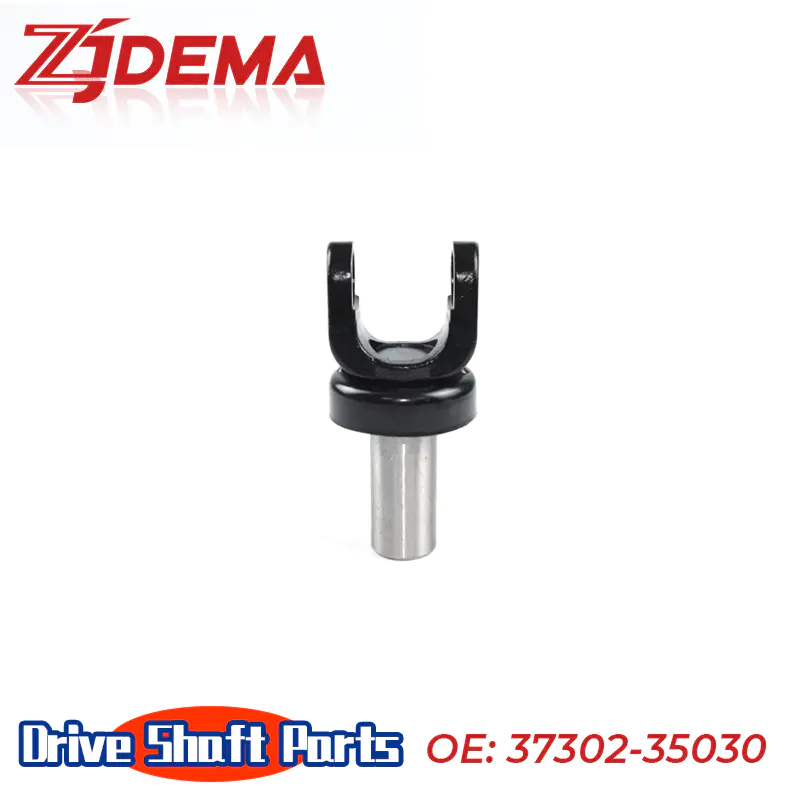
The 37302-35030 version, for example, is structured as a sliding fork with an internal spline and is used in applications where the driveshaft needs axial expansion. Its listed overall dimension is 60 mm, with a 25+10+25 mm configuration.
This illustrates why sliding yoke dimensions need to correspond with the complete driveshaft assembly rather than being selected from outside measurements alone.
Steel Supports Repeated Mechanical Loading
A Steel Slip Yoke operates under repeated torque and movement, so material selection is closely connected with its service conditions. The specified component uses alloy steel with forging and heat-treatment processes before precision grinding.
Heat treatment can change hardness and toughness, while forging establishes the initial component shape. These processes need to work together because the part must support both rotational loading and repeated axial movement.
For driveshaft components, material and manufacturing route are therefore closely connected with the expected load cycle.
Precision Machining Controls the Spline Fit
The spline is one of the sensitive areas of a Steel Slip Yoke because it needs to engage smoothly with its mating shaft. Precision grinding can control tooth dimensions and reduce excessive clearance.
The listed 37302-35030 specification identifies CNC grinding with tolerances controlled within ±0.02 mm. Such dimensional control helps maintain the intended relationship between the sliding yoke and its matching shaft.
For sliding yoke replacements, spline accuracy can be more useful for compatibility checking than simply comparing the outer shape of two components.
Sealing Protects the Sliding Area
The sliding connection is exposed to contamination from the operating environment. Dust, mud, and moisture can reach the spline area if suitable protection is not provided.
A Steel Slip Yoke may therefore be combined with rubber seals or oil seals around the sliding section. These components help limit contamination and retain lubrication around the contact surfaces.
For driveshaft components, sealing and lubrication become especially relevant when vehicles operate on unpaved roads or in other environments where dirt can reach exposed drivetrain areas.
Vehicle Compatibility Determines the Specification
A Steel Slip Yoke cannot be selected only by its general name because different vehicles can use different spline dimensions, lengths, flange structures, and connection arrangements.
The 37302-35030 model is listed for specific vehicle applications and uses a defined connection structure between the driveshaft and transfer-case output. Buyers therefore need to confirm the OE code, vehicle model, spline arrangement, and installation position before ordering.
This is equally relevant when sourcing sliding yoke replacements for aftermarket maintenance.
Replacement Can Target One Worn Component
A worn sliding yoke does not always mean the complete driveshaft assembly needs to be replaced. Where the surrounding components remain suitable, replacing the individual connection component can be a more targeted maintenance approach.
A Steel Slip Yoke is therefore relevant to replacement-parts markets where repair businesses and distributors supply individual drivetrain components instead of complete assemblies.
The practical decision depends on the condition of the yoke, spline, shaft, universal joints, and other connected parts.
The Slip Yoke Connects Movement With Power Transfer
The role of a Steel Slip Yoke sits between two requirements that must happen simultaneously: the driveshaft needs to transmit torque, and it needs to accommodate changes in axial length.
For B2B buyers, the important specifications include spline dimensions, overall length, material, heat treatment, sealing arrangement, vehicle compatibility, and installation position. These details help distinguish one sliding yoke from another within the broader market for driveshaft components.
A Steel Slip Yoke may be a relatively small part of the drivetrain, but its sliding connection directly relates to suspension movement and driveshaft geometry. That makes accurate machining and correct vehicle matching central to its role in the complete transmission system.
Recommended Articles
No. 228, Yongning Road, Xiping Street, Songyang County, Zhejiang, China 323400
+86-578-8066777 (Fax)
+86-578-8066585 / +86-578-8066520(Tel)
+86-18157882233 / +86-19905880068(Cellphone/WeChat)
+86-13506650773 / +86-19905880068(Whatsapp)
sales_nicole@zjdemai.com / sales_janny@zjdemai.com (Email)
