


 English
 русский
 Español
 中文简体
中文简体
Custom Propeller Shaft Design Matches Application-Specific Driveline Requirements
Date:Sep 11, 2026
A propeller shaft has a straightforward job: transfer rotational power from one part of a drivetrain to another. The engineering behind that job becomes less straightforward when the available installation space, connection points, operating angle, or power requirements differ from one application to another. This is where a Custom Propeller Shaft can provide a more suitable solution than a standard shaft built around general dimensions.
Customization is not simply about changing shaft length. A complete shaft assembly has to work with the components connected at both ends, while maintaining the required relationship between rotation, alignment, support, and available installation space.
Length Is Only The Starting Point
Driveline layouts can vary significantly between vehicles and machinery. The distance between the transmission and driven axle may change, while available space around the shaft can also be restricted by the surrounding structure.
A shaft that is too long may not fit the intended installation, while excessive shortening can affect the relationship between connected components. For this reason, shaft length is normally considered together with the positions of the mating components.
For a Custom Propeller Shaft, dimensional information such as working length and end locations provides the starting point for developing an application-specific configuration.
End Connections Determine Compatibility
A shaft does not operate independently. Its ends have to connect correctly with the transmission, differential, gearbox, coupling, or other drivetrain components.
Flanges, yokes, splines, keyways, and other interfaces can differ between applications. Even when two shafts appear similar externally, their connection geometry may prevent them from being interchangeable.
This makes interface information particularly valuable during custom shaft development. The dimensions and orientation of both ends need to correspond with the components already installed in the drivetrain.
Operating Angles Affect Shaft Design
The shaft may not always run in a perfectly straight line between the power source and driven component. Changes in suspension position, chassis layout, or equipment configuration can create working angles.
Universal joints and other connection components allow the drivetrain to accommodate these changes, but the shaft assembly still needs to operate within the intended geometric conditions.
A Custom Propeller Shaft can be configured around the actual driveline arrangement rather than forcing the application to conform to a generic shaft dimension. This becomes particularly useful for modified vehicles, specialized equipment, and machinery with non-standard layouts.
Material Selection Follows The Application
Shafts operate under rotational and torsional loads, so material selection is closely connected with the intended working conditions.
Steel remains widely used for driveline components, while other material options may be considered where weight, strength, corrosion resistance, or specific application requirements call for a different approach.
The material decision should not be separated from shaft dimensions and operating conditions. Diameter, wall structure, rotational speed, torque, and support arrangement all contribute to the overall mechanical requirements.
Balancing Becomes More Important At Higher Speeds
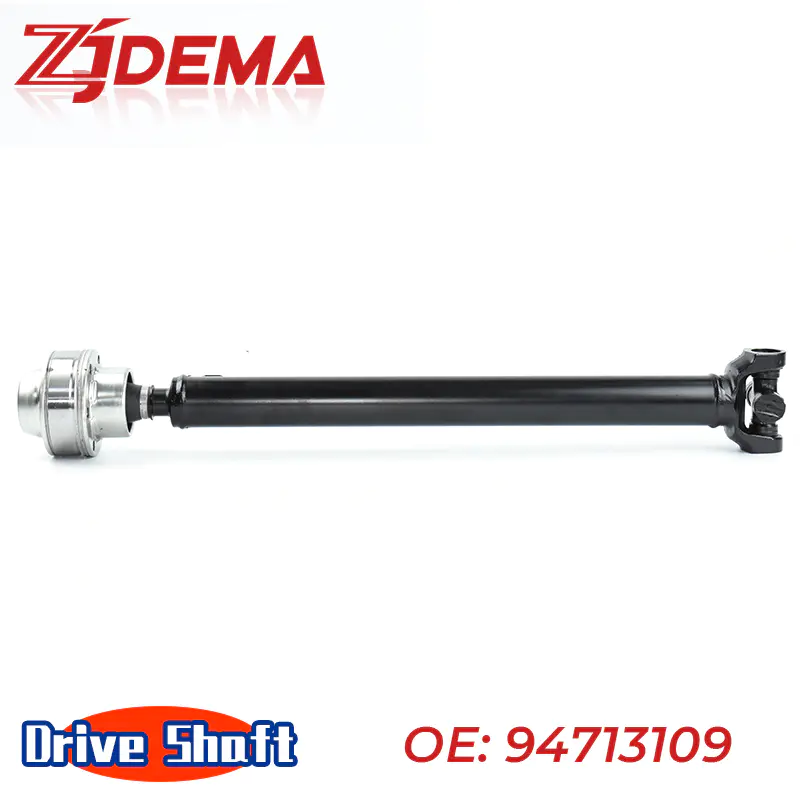
A rotating shaft needs to maintain a suitable balance during operation. Even a relatively small imbalance can become more noticeable as rotational speed increases.
This is one reason balancing is an important part of propeller shaft manufacturing and assembly. The shaft itself, together with its connected components, needs to rotate smoothly within the intended operating range.
For custom applications, balancing requirements can be especially relevant because the shaft may differ from standard production configurations in length, diameter, or component arrangement.
Customization Extends Beyond New Vehicles
Not every custom shaft is developed for a completely new machine. Existing equipment may be modified because of a drivetrain conversion, chassis change, replacement requirement, or altered operating configuration.
In these situations, a standard shaft may not match the new distance or connection geometry. A Custom Propeller Shaft can instead be developed around the updated arrangement, allowing the shaft to fit the revised drivetrain.
This application is particularly relevant when older equipment is being refurbished or when specialized machinery requires a combination of existing and newly installed components.
Precision Manufacturing Supports The Final Fit
Once the shaft configuration has been established, machining accuracy becomes important. End interfaces, splines, flanges, keyways, and bearing-related surfaces all need to correspond with their mating components.
CNC machining can be used for controlled production of these features, while dimensional inspection helps verify that the finished shaft matches the intended design.
The objective is not simply to produce a shaft with the correct overall length. The complete component needs to fit into the drivetrain as designed and maintain the required mechanical relationship between its connected parts.
Custom Shafts Follow The Drivetrain, Not The Other Way Around
The main advantage of a Custom Propeller Shaft is its ability to accommodate application-specific requirements that a generic component may not address. Length, diameter, material, connection interfaces, operating geometry, and balancing requirements can all form part of the engineering process.
As vehicles and industrial machinery become more specialized, driveline components increasingly need to fit the actual architecture of the equipment. A custom shaft provides a way to translate those dimensional and mechanical requirements into a component designed for the intended installation rather than relying on a one-size-fits-all configuration.
Recommended Articles
No. 228, Yongning Road, Xiping Street, Songyang County, Zhejiang, China 323400
+86-578-8066777 (Fax)
+86-578-8066585 / +86-578-8066520(Tel)
+86-18157882233 / +86-19905880068(Cellphone/WeChat)
+86-13506650773 / +86-19905880068(Whatsapp)
sales_nicole@zjdemai.com / sales_janny@zjdemai.com (Email)
