


 English
 русский
 Español
 中文简体
中文简体
Precision Car Part Design Connects Accuracy With Vehicle Performance
Date:Sep 04, 2026
A vehicle transmission system is made up of many individual components, but these parts do not work independently. A small component can determine how accurately larger assemblies connect, rotate, or transfer force. This is where a Precision Car Part becomes more than a machined metal component. Its dimensions, interfaces, material properties, and manufacturing accuracy all have to correspond with the system around it.
For automotive manufacturers and aftermarket distributors, precision is therefore closely related to compatibility. A component may look correct from the outside, yet differences in key dimensions or connection features can affect installation and operation.
Small Dimensional Differences Can Affect The Complete Assembly
Automotive components often have to fit within tightly defined spaces. Shafts, joints, yokes, flanges, and other transmission-related parts must maintain the correct relationship with mating components.
A difference in diameter, length, hole position, spline geometry, or connection surface can change how two components fit together. In rotating assemblies, these differences may also influence alignment and vibration.
For a Precision Car Part, controlling these critical dimensions during machining is therefore an important part of achieving consistent assembly results. The objective is not simply to make a component look uniform, but to ensure that its functional surfaces correspond with the intended application.
Connection Interfaces Require More Than Basic Machining
Automotive transmission components commonly use specialized connection structures. Splines, flanges, yokes, keyways, and bearing-related surfaces each serve different mechanical purposes.
These interfaces transfer torque or maintain the position of connected components, so their geometry needs to match the corresponding part. A spline, for example, needs suitable tooth geometry and engagement with its mating shaft rather than simply having the correct overall diameter.
This makes machining strategy particularly important. Turning, milling, grinding, and CNC processing may all be used depending on the feature being produced. Each operation contributes to the final dimensional relationship between the component and the rest of the assembly.
Material Choice Is Part Of Precision Engineering
Precision does not only concern measurements. The material selected for an automotive component also influences how it responds to mechanical loads, wear, and manufacturing processes.
Steel and alloy steel are widely used for drivetrain components because different grades can provide combinations of strength and toughness suited to particular applications. Heat treatment may further modify the mechanical characteristics of selected components.
For a Precision Car Part, material selection therefore needs to be considered together with its intended function. A component designed to transmit torque has different requirements from one primarily used as a connection or support element.
Rotating Components Need Attention To Balance
Many automotive parts operate as part of rotating assemblies. In these applications, dimensional accuracy and balance are closely related.
If a rotating component is not manufactured or assembled within the intended geometry, uneven rotation can contribute to vibration and noise. This is particularly relevant to drive shaft assemblies, where several individual components work together at relatively high rotational speeds.
Dynamic balancing can be used during assembly and inspection to evaluate the behavior of rotating components. For precision automotive manufacturing, this provides another layer of control beyond checking individual dimensions.
Precision Also Means Consistency Between Batches
For aftermarket and OEM applications, one acceptable component is not enough. Repeated production needs to deliver components with consistent dimensions and functional characteristics.
This is where CNC machining, controlled production processes, and inspection equipment become valuable. Modern automotive component manufacturing can combine machining centers, precision measuring equipment, material testing, and other inspection methods to monitor production quality.
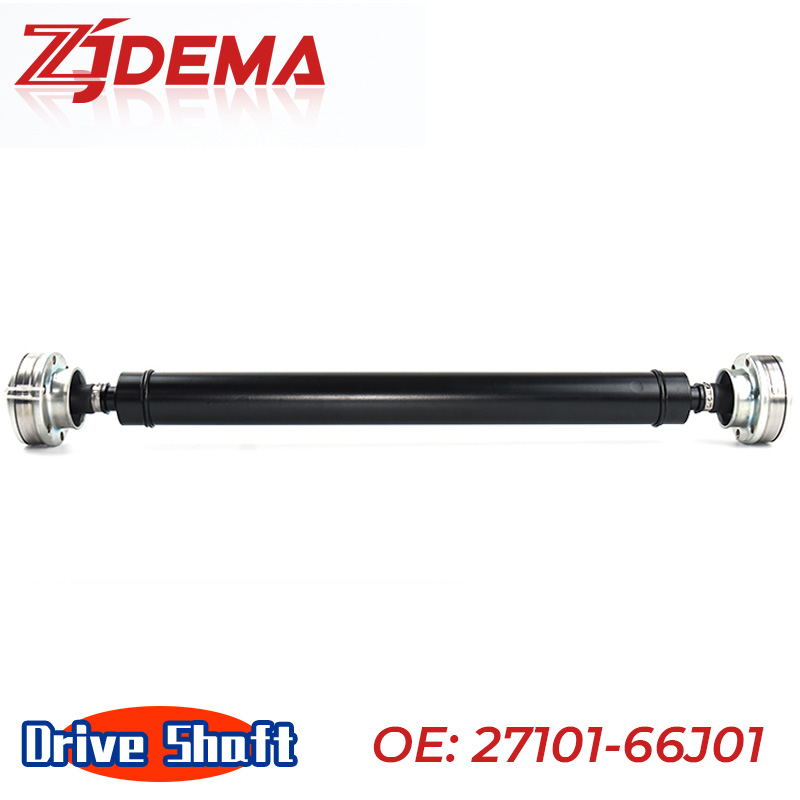
A Precision Car Part produced consistently across multiple batches can simplify assembly, replacement, and inventory management because buyers are working with a predictable component specification rather than a product that varies from one production run to another.
Vehicle Diversity Makes Component Matching More Important
Automotive parts are not designed around one universal vehicle configuration. Passenger cars, commercial vehicles, agricultural vehicles, ATVs, and specialized equipment can use different transmission and steering arrangements.
Even components performing similar functions may therefore differ in dimensions, connection methods, or load requirements.
This is particularly relevant for replacement parts. Matching the vehicle model, OE number, dimensions, and connection configuration helps determine whether a component is suitable for the intended application. For international buyers handling multiple vehicle platforms, accurate product identification can be just as important as the manufacturing process itself.
Inspection Connects Manufacturing With Application
Precision manufacturing only has value when the finished component can be verified against its intended requirements. Dimensional inspection, hardness testing, material analysis, and functional testing can all play a role depending on the component.
For rotating transmission parts, inspection may also include dynamic balancing. For machined interfaces, measurement equipment can be used to check critical dimensions and geometric features.
The result is a production approach in which precision is treated as a combination of design accuracy, process control, material selection, and final inspection rather than as a single machining step.
Precision Parts Support More Reliable Automotive Assemblies
A Precision Car Part is ultimately defined by how well it fits and functions within the larger vehicle system. Accurate dimensions, suitable materials, correctly formed interfaces, controlled machining, and appropriate inspection all contribute to that result.
As automotive platforms become more diverse, component manufacturers need to produce parts that correspond closely with specific vehicle and drivetrain requirements. Precision manufacturing provides the foundation for that compatibility, helping individual components perform their intended role within a much larger mechanical system.
Recommended Articles
No. 228, Yongning Road, Xiping Street, Songyang County, Zhejiang, China 323400
+86-578-8066777 (Fax)
+86-578-8066585 / +86-578-8066520(Tel)
+86-18157882233 / +86-19905880068(Cellphone/WeChat)
+86-13506650773 / +86-19905880068(Whatsapp)
sales_nicole@zjdemai.com / sales_janny@zjdemai.com (Email)
